A Song with First Conditional, Imperatives, and Collocations

Image result for dua lipa don't start now album cover

Dua Lipa – Don’t Start Now

Dua Lipa sings a song, Don’t Start Now, in which she tells an ex boyfriend very clearly that their relationship is finished and she is not interested in seeing him again. Her life is so much better without him. Her message to him is clear: If you don’t want to see me with another man, don’t look!

Click on the above picture for the official YouTube video. For the YouTube video with lyrics, click here.

Sentences starting with ‘If” are usually conditional sentences, and Dua Lipa is telling her ex what not to do in the future if he doesn’t want to see her with another man. Because she is referring to possible future situations, the sentence structure is First Conditional. Because she is warning him about possible future actions, she uses Imperatives:

Walk away!


Don’t show up;

Don’t come out;

Don’t start caring about me now.

Walk away;

› › › › › › › › ›

You may have studied First Conditional with WILL + Base Infinitive. If you would like to revise the rules for First Conditional with WILL, click here. Today, however,  I’m focusing on First Conditional with Imperative Verbs.


♥ The chorus is one long First Conditional sentence:

If you don’t *wanna see me dancing with somebody;            *want to
If you *wanna believe that anything could stop me,
Don’t show up;
Don’t come out;
Don’t start caring about me now;
Walk away; you know how;
Don’t start caring about me now.

Conditional Sentences are Complex Sentences, which means that they include at least one Dependent Clause (blue print) and at least one Independent Clause (green print). The chorus includes two Dependent Clauses and five Independent Clauses.


                                            ♥ Note the Imperative Verbs

https://unsplash.com/photos/QL0FAxaq2z0

Imperatives


Don’t show up

 Don’t come out

 Don’t start

 Walk away


♥ The song provides numerous Collocations, here in bold:

Did a full one-eighty …
But look at where I ended up.
I’m all good already;

So moved on, it’s scary.
I’m not where you left me at all,
Don’t show up;
Don’t come out;
I’m better on the other side.
Walk away.

Can you work out the meanings of the above collocations? Look at what you can understand. She is telling someone: ‘Don’t … Don’t … Don’t … Don’t … I’m all good … I’m better …”   When Collocations are idioms, you can often work out the meaning if you know the context.     

Did a full one-eighty … 

To do a one-eighty (180°) is to change your thinking and/or actions completely: to think or do the opposite. The singer thinks about the way she was before and the way she is now – from heartbroken (maybe) to ‘all good’.

But look at where I ended up.

To end up is to eventually finish, to end a situation. The singer was possibly heartbroken but at the end, she was ‘all good’. For more examples of ended up, click here.

https://unsplash.com/photos/zdSoe8za6Hs

I’m all good!   I’ve moved on!


I’m all good already

She is not just ‘good’; she is great, completely okay. Don’t worry! (‘Already’ means ‘sooner than expected’.)

 ♦ So moved on

To move on from a relationship means to accept that the relationship is over, finished, and to be ready for a new relationship, a new life.

So … , it’s scary.

So + adjective/adverb, it’s scary, means that something (or someone) is so bad / wonderful / clever etc. that it is hard to believe. The singer has moved on and recovered so quickly and easily from the relationship that it is impressive and hard to believe – it’s scary.

I’m not where you left me at all

Literally, where you left me, means the last place you saw me. However, here it means that she is not the sad, rejected person he said ‘goodbye’ to. She has moved on.

Don’t!

     ♦ Don’t show up

To show up means to arrive. For example, All the employees were expected at the Christmas party but fewer than half showed up.

      ♦ Don’t come out

Meaning: Don’t leave your house. Stay at home. If you don’t want to see me with another man, don’t leave your house!

 the other side

I’m better on the other side. Her life is better now after the end of the relationship. The experience has been like a journey and she has come through to the other side. She is no longer in the journey or experience. She is at a distance from it: the other side.

Walk away.

To walk away from someone or something means to leave or abandon the person or situation. She tells him to walk away, leave her. She reminds him that he knows how to walk away because he had abandoned her more than once. 

For more examples of walk away, click here.

Click here for a free idioms and phrases dictionary. 

      

Posted in Grammar, IELTS, Intermediate (Level 4), Listening, Pre-Intermediate (Level 3), Songs, Upper Intermediate (Level 5) | Tagged , , | 4 Comments

Mercy & Cancel Culture – Advanced Reading

Nick Cave is a is an Australian singer, songwriter, author, and screenwriter. On his website, The Red Hand Files, he answers questions from fans, any questions about anything. In this post, I’m featuring his eloquent response to the questions: What is mercy for you? What do you think of cancel culture? 

∼∼∼∼∼∼∼∼∼∼∼∼∼∼∼∼∼∼

Logo

The Red Hand Files


What is mercy for you?

VALERIO, TURIN, ITALY


What do you think of cancel culture?

FRANCES, LOS ANGELES, USA


Dear Valerio and Frances,

Mercy is a value that should be at the heart of any functioning and tolerant society. Mercy ultimately acknowledges that we are all imperfect and in doing so allows us the oxygen to breathe — to feel protected within a society, through our mutual fallibility. Without mercy a society loses its soul, and devours itself.

Mercy allows us the ability to engage openly in free-ranging conversation — an expansion of collective discovery toward a common good. If mercy is our guide we have a safety net of mutual consideration, and we can, to quote Oscar Wilde, “play gracefully with ideas.”

Yet mercy is not a given. It is a value we must nurture and aspire to. Tolerance allows the spirit of enquiry the confidence to roam freely, to make mistakes, to self-correct, to be bold, to dare to doubt and in the process to chance upon new and more advanced ideas. Without mercy society grows inflexible, fearful, vindictive and humourless.

Frances, you’ve asked about cancel culture. As far as I can see, Read more … 

∼∼∼∼∼∼∼∼∼∼∼∼∼∼∼∼∼∼

Posted in Advanced (Level 6+), Cambridge, Reading, Writing | Tagged , | Leave a comment

Phrasal Verbs: 3 Easy Rules

Phrasal Verbs

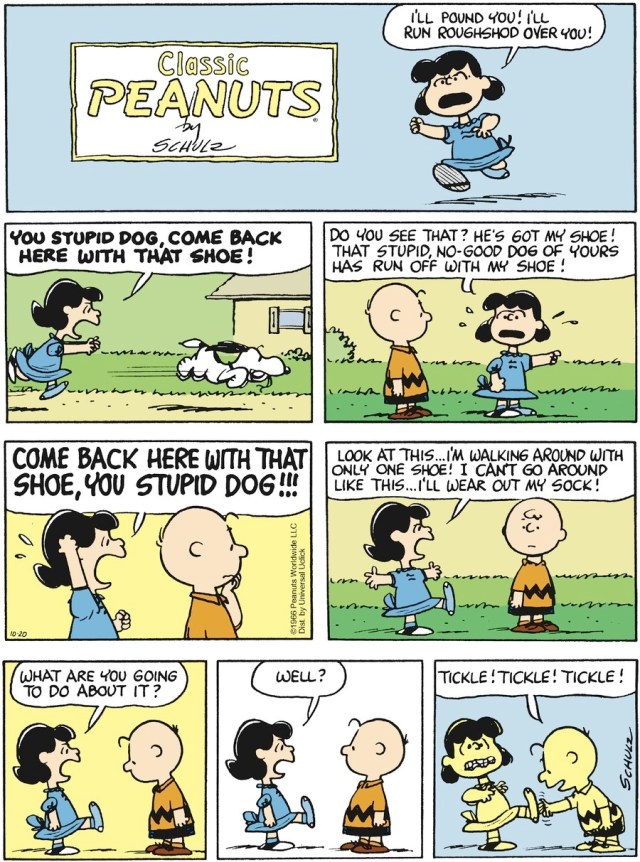
Phrasal Verbs: come back, run off with, go around, wear out, ………. http://www.anglonautes.eu/learning%20english

There are just 3 things to know if you want to understand and remember Phrasal Verbs:

1. Phrasal Verbs are Vocabulary.

2. There are two types: a)Separable and
b)Non-separable.

3. When they are Separable, the pronoun must always go in the middle.

Phrasal Verb: get up ..................... https://www.google.com.au/search?q=peanuts+cartoons

Phrasal Verb: get up .……………….. https://www.google.com.au/search?q=peanuts+cartoons

https://s-media-cache-ak0.pinimg.com

Phrasal Verb: give up ………………….. https://s-media-cache-ak0.pinimg.com

1. Phrasal Verbs are Vocabulary.

Phrasal Verbs are verbs plus one or more words which change the meaning of the verb. Think of them as one vocabulary unit with one meaning

You know the meaning of the verb give.

1. Please give me that football.

 You also know the meaning of give up.

2. I’m not a great football player but I’m never going to give up!

Sentences 1. and 2. both use the word give, but the meaning is different.

It’s important to learn and remember that the Phrasal Verb give up means *to stop an activity or effort : to admit that you cannot do something and stop trying It has no connection with the word give or the word up. No-one is giving anything. No-one is looking up.

*This is a link to the definition of give up in the online dictionary www.learnersdictionary.com You will need to scroll down, down, down to the phrasal verb section to find the definition that I’ve included above. You may have to click on give verb first.

How can you learn all these Phrasal Verbs? Well, how do you learn other vocabulary? Here are my suggestions. Check:

♦  www.learnersdictionary.com

♦  Google – Images
     For more Phrasal Verb Cartoons, click here.

♦  Google.com

♦  http://idioms.thefreedictionary.com

Don’t worry if it takes you a long time to work out the meanings of the Phrasal Verbs. While you are trying to work out the meanings (using my suggestions), you are learning much more than you realise. You are learning how to use the new vocabulary in context.

When you look up Phrasal Verbs like give up, you will see how the word give has multiple meanings. You will see that give up is not the only Phrasal Verb that starts with the word give. The two minutes you spend looking up give up will be a mini lesson; you will learn so much more than just one phrasal verb.

For a list from www.englishclub.com of the 200 most common Phrasal Verbs, with explanations and example sentences, click here.


2. There are two types: a)Separable and
b)Non-separable.

Sometimes you can separate the words that make up a Phrasal Verb:

I really need to give up smoking.

Everyone tells me that I need to give smoking up.

Everyone tells me that I need to give it up.

Sometimes, you cannot separate the words that make up a Phrasal Verb. (‘Non-separable’ means that you must not separate the words.)

You should stick to your exercise routine.

I can’t go around like this! (go around = to go here and there; move from place to place)

Charlie Brown looks after his dog Snoopy.

        I got up early today to study for my exam.

Non-separable Phrasal Verbs are not hard to remember and students don’t make the mistake of separating them. I have never heard a student separate a non-separable Phrasal Verb. I have never, ever, ever heard anything like:

You should stick your exercise routine to .

I can’t go like this  around.

I look my dog after.

        I got early up today to study for my exam.

There is a good reason why English learners don’t make the mistake of separating Non-separable Phrasal Verbs. They sound really bad if you separate them! This is an easy rule to remember. However, you need to know it because of rule .


3. When  Phrasal Verbs are Separable, the pronoun must always go in the middle.

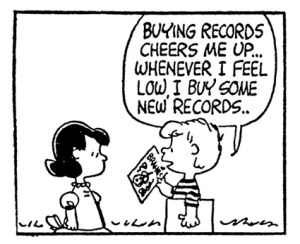
cheers-me-up

I’ll wear out my sock!

I’ll wear my sock out!

I’ll wear it out.                                      

Buying records cheers up my friends.

Buying records cheers  my friends up.

Buying records cheers them up.

You should give up smoking.

You should give smoking up.

You should give it up.

Phrasal Verbs like wear out, cheer up, and give up can be separated. If you use a pronoun, you must, must, must, put it in the middle. You cannot put it after the Phrasal Verb. You cannot say:

I’ll wear out it .   

Buying records cheers up them.

You should give up it .

Have a look at the 200 examples of common Phrasal Verbs with explanations and example sentences at English Club. Take note of the Non-separable Phrasal Verbs. They are the ones  with pronouns after the Phrasal Verbs. For example:

We called on you last night but you weren’t home.

I am counting on you to make dinner while I am out.

Now, take note of the Separable Phrasal Verbs. They are the ones  with pronouns or nouns in the middle of the Phrasal Verbs.

For example:

My wife backed me up over my decision to quit my job.

This sad music is bringing me down.

His wife gave him away to the police.

        Our teacher broke the final project down into three separate parts.

         I need to break these shoes in before we run next week.

        Do your coat up before you go outside. It’s snowing!

So, there you have it. Remember the three rules and don’t worry. You already know a lot of phrasal verbs. They are just more vocabulary. Look at the list of 200 Phrasal Verbs. Read the explanations and examples. It won’t take long to learn the meanings. The main thing to remember is: do not put the pronoun after a separable Phrasal Verb! If you can put it in the middle, you must put it there!

Have fun and just think of how much you are improving your English knowledge every time you learn a new Phrasal Verb!

♦♦♦♦♦♦♦♦♦♦♦♦♦♦♦♦♦♦♦♦♦♦♦♦

Posted in Grammar, Intermediate (Level 4), Upper Intermediate (Level 5), Vocabulary, Writing | Tagged | 4 Comments

Improve your English with a British Council approved tutor

Hello students!
As you know, I’m taking a break from teaching English (while I complete my e-book). Meanwhile, I have found the perfect online option for you! The best advice I can give to all my English students is to get a tutor.

I’ve partnered with EnglishScore Tutors –  British Council’s official 1:1 tutoring platform.

I have  used the excellent resources provided by British Council frequently on this website. Because of this, I am confident that their one-on-one tutoring service would help you improve your spoken English, vocabulary, and more, with instant feedback and support.

It’s comforting to keep in mind that English Second Language Teachers can often speak  a second or third language themselves. You can practise with your British Council approved English tutor and not be worried about mistakes or pronunciation because they have experienced them themselves!

EnglishScore Tutors is British Council’s Official 1-to-1 tutoring service, helping over 12,500 adults and young learners improve their English. The platform hosts over 150 qualified English tutors who are available for private classes 24/7, which will work with your busy schedule. 

Whether you are looking to improve your business English, prepare for an exam like IELTS, or just gain confidence speaking, EnglishScore Tutors offers you personalised sessions designed around you and your goals.

The good news is that you can try your first 30 minute session for just $1. Really!

Get your $1 lesson here.

I’d love to get some feedback! Let me know about your experience with  EnglishScore Tutors. 

Go back

Your message has been sent

Warning
Warning
Warning
Warning

Warning.

Posted in Advanced (Level 6+), Cambridge, Children, Elementary (Level 2), IELTS, Intermediate (Level 4), Pre-Intermediate (Level 3), Speaking & Pronunciation, TOEFL, TOEIC, Upper Intermediate (Level 5) | Leave a comment

Season’s Greetings to you all!

🎄 Greetings Dear English Learners! 🎄

It’s that time of year again when some of us celebrate  Christmas and, or, welcome Santa, and some of us just want to welcome in the New Year and leave 2021 far behind!

Whatever you decide to do, I hope you enjoy the Festive Season and I wish you success and happiness in the New Year! It’s not Christmas for me without a Christmas song. This year, I’m presenting an old favourite by John Lennon of The Beatles. Click on the video at the end. I hope you enjoy it as much as I do!

🎄 🎄 🎄 🎄 🎄 🎄 🎄 🎄

🎄 🎄 🎄 🎄 🎄 🎄 🎄 🎄 🎄 🎄 🎄 🎄 🎄

Time for a song! Click on the video to hear John Lennon‘s Christmas song: 

Posted in Advanced (Level 6+), Elementary (Level 2), IELTS, Intermediate (Level 4), Listening, Pre-Intermediate (Level 3), Songs, Upper Intermediate (Level 5), Videos | 5 Comments

English Grammar Quiz

Hello English Students! The end of the year is fast approaching  and I wonder how you have all managed with your English studies. Are you happy with your progress? Perhaps it’s time to test your grammar skills?

I am more than halfway through watching a Turkish TV Series called Magnificent Century. (There are more than 130 episodes!) I am enjoying it immensely; however, I don’t speak Turkish so I have been reading the English sub-titles. 

Translating a fast-paced TV Series is a huge undertaking. The people responsible for translating Magnificent Century into English did a remarkable job in limited time. I was impressed with their advanced level of grammar. Nonetheless, I noticed that as with other non-English films, the English sub-titles contain the same familiar errors repeatedly, most of which are lower level grammar and are used in everyday conversation. 

If your English level is Pre-intermediate or above, you should be able to find some, or all, of the mistakes in the following quotes from the TV Series. Cambridge students should ace this quiz! Check the answers at the end. Click on the links for grammar explanations. 

https://www.criticsatlarge.ca/2015/05/the-magnificent-century-muhtesem-yuzyil-harim-sultan.html

The main cast of Magnificent Century

Grammar Quiz

Can you find one mistake in each example?

1. The news are not good.

2. Lufti Pasha has the experience for this promotion. He has many services in every government position.

3. Ibrahim Pasha has protected you for many years. (*Note: Ibrahim Pasha is dead.)

4. I want to raise my children in your own home!

5. Get all my stuff out of here and clean them.

6. Now you live in this chambers.

7. I’m working on it since a long time.

8. For a long time, there is a senseless malice between us.

9. I will not let me get rid of them!

10. There will always be people who wants to dig a pit for you.

11. Find her and take her here.

12. The gold were in a purse with Hatice Sultana’s name written on it.

13. The investigation is continuing. If they will be arrested, they’ll pay for it.

14. How dare she wants something from me!

15. These are serious accusations. Does he have a proof?

16. Unfortunately, there are still no news from Cafer Aga.

17. You will be notified of everything that will happen here.

18. Is there a bad news?

19. What are these, Ibrahim’s gold?

20. If the treasure will be found, we’d be blamed.

21. Everything you heard about me are slanders and lies.

22. I should to go.

23. Let’s hope they find him and take him back here.

24. Take my son to me immediately!

https://www.peakpx.com/en/hd-wallpaper-desktop-pexpq

25. When the preparations will be finished, he will start the India campaign.

26. Raresh rioted against our Sultan by killing Alvise Gritte who serves the Ottoman Empire.

27. I know her since many years.

28. From what he told me, some of our soldiers harrasses and steals from people.

29. Leave now and bring this letter to his majesty.

30. It is ever a problem in the palace.

https://unsplash.com/photos/qUey2pOvbvc

Mistakes & Corrections

1. The news are not good.
1. The news is not good. (‘News’ is an uncountable noun.)

2. Lufti Pasha has the experience for this promotion. He has many services in every government position.
2. Lufti Pasha has the experience for this promotion. a) He has provided  many services in every government position. b) He has worked (in many services) in every government position.

3. Ibrahim Pasha has protected you for many years. (*Note: Ibrahim Pasha is dead.)
3. Ibrahim Pasha protected you for many years.  

4. I want to raise my children in your own home!
4. I want to raise my children in my own home!

5. Get all my stuff out of here and clean them.
5. Get all my stuff out of here and clean it. (‘Stuff’ is an uncountable noun.)

6. Now you live in this chambers.
6. Now you live in these chambers. (this chamber / these chambers)

7. I’m working on it since a long time.
7. I have been working on it for a long time. 

8. For a long time, there is a senseless malice between us.
8. For a long time, there has been a senseless malice between us.

9. I will not let me get rid of them!
9. I will not let them get rid of me!

10. There will always be people who wants to dig a pit for you.
10. There will always be people who want to dig a pit for you. (‘People’ is a plural noun.)

11. Find her and take her here.
11. Find her and bring her here. ( Bring here. Take there.)

12. The gold were in a purse with Hatice Sultana’s name written on it.
12. The gold was in a purse with Hatice Sultana’s name written on it. (‘Gold’ is an uncountable noun.)

13. The investigation is continuing. If they will be arrested, they’ll pay for it.
13. The investigation is continuing. If they are arrested, they’ll pay for it.

14. How dare she wants something from me!
14. How dare she want something from me! (In this sentence, ‘dare’ is a finite verb: Present Simple Tense. ‘Want’ is a non-finite verb: Base Infinitive.)

15. These are serious accusations. Does he have a proof?
15. These are serious accusations. a) Does he have any proof?
     b) Does he have proof?
(‘Proof’ is an uncountable noun.)

16. Unfortunately, there are still no news from Cafer Aga.
16. Unfortunately, there is still no news from Cafer Aga. (‘News’ is an uncountable noun.)

17. You will be notified of everything that will happen here.
17. You will be notified of everything that happens here.

18. Is there a bad news?
18. Is there bad news? (‘News’ is an uncountable noun.)

19. What are these, Ibrahim’s gold?
19. What is this, Ibrahim’s gold? (‘Gold’ is an uncountable noun.)

20. If the treasure will be found, we’d be blamed.
20. If the treasure is found, we’d be blamed. 

21. Everything you heard about me are slanders and lies.
21. Everything you heard about me is slanders and lies. (‘Everything’ is a singular noun.)

22. I should to go.
22. I should go.

23. Let’s hope they find him and take him back here.
23. Let’s hope they find him and bring him back here.

24. Take my son to me immediately!
24. a) Bring my son to me immediately! b) Take me to my son immediately!

25. When the preparations will be finished, he will start the India campaign.
25. When the preparations are finished, he will start the India campaign.

26. Raresh rioted against our Sultan by killing Alvise Gritte who serves the Ottoman Empire.
26. Raresh rioted against our Sultan by killing Alvise Gritte who served the Ottoman Empire.

27. I know her since many years.
27. I have known her for many years.

28. From what he told me, some of our soldiers harrasses and steals from people.
28. From what he told me, some of our soldiers harrass and steal from people. (‘Soldiers’ is a plural verb.)

29. Leave now and bring this letter to his majesty.
29. Leave now and take this letter to his majesty.

30. It is ever a problem in the palace.
30. It is always a problem in the palace.

🌷 🌷 🌷 🌷 🌷 🌷 🌷

Posted in Cambridge, Grammar, IELTS, Intermediate (Level 4), TOEFL, TOEIC, Upper Intermediate (Level 5), Writing | Tagged , , , , | 1 Comment

English Words that are often Confused #1

I have written two posts on Spelling Mistakes that Ruin your Writing. They are a small number of mistakes which are easily fixed as soon as you understand the grammar. Don’t worry! The grammar is basic and easily understood.

Today, I’m focusing on other common mistakes. These are words that native speakers use incorrectly. I hope you find my explanations helpful.

I will list the confusing words in alphabetical order. Today, I’m dealing with ‘A’. If you would like to receive all my future posts explaining confusing words, just click on ‘Follow’.

https://unsplash.com/photos/-9JAqVxg3vs

Looking at baby animals, especially baby elephants, usually has a positive effect on people.

Let’s have a look at some confusing words:                  

a) advice, advise           
     b) affect, effect
c) agree with, agree to, agree on
     d) alternate, alternative           
e) among, between
     f) anticipate, expect           
g) approve, approve of


♦ ♦ ♦ ♦ ♦ ♦ ♦ ♦ ♦ ♦ ♦ ♦ ♦ ♦ ♦ ♦ ♦ ♦

a) advice, advise

advice  –  noun

Do you think this is good advice?

My advice is to look at the spelling. The word ‘advice’ contains the word ‘ice’ which is also a noun.

We often need advice from an expert.

We sometimes receive the best advice when we least expect it.


         ♦ advise  –  verb

Did your parents advise you to save your money?

Who advises the football coach?

I advise you to keep reading.


♦ ♦ ♦ ♦ ♦ ♦ ♦ ♦ ♦ ♦ ♦ ♦ ♦ ♦ ♦ ♦ ♦ ♦

 b) affect, effect


affect   verb (used with object: this means that the subject  affects something or someone)

In France, the extremely cold winter of 2018-2019 affected many vineyards
Do you believe that your thinking affects your actions?         樂 


effect   noun

Looking at baby animals, especially baby elephants, usually has a positive effect on people.

Were you impressed with the special effects used in the movie Avatar?


Note: ‘Effect’can also be used as a verb but take care. While ‘affect means ‘to change’, ‘effect’ means ‘to bring about/cause’ a change. It is usually used in formal speaking and writing. I advise consulting a dictionary if you wish to use ‘effect’ as a verb.

The President hopes to effect new laws to deal with drug trafficking.

♦ ♦ ♦ ♦ ♦ ♦ ♦ ♦ ♦ ♦ ♦ ♦ ♦ ♦ ♦ ♦ ♦ ♦

c) agree with, agree to, agree on

Do you agree with Satya Nani that a little progress each day adds up to big results?

agree with  someone

I agree withSatya Nani that “A little progress each day adds up to big results”.

agree to  something, usually a plan or scheme.

I should never have agreed to look after his stupid dog!

agree on a choice or result with other people

Sheldon and Amy agreed to get married but they couldn’t agree on when or where, nor could they agree on whom to invite to their wedding.

♦ ♦ ♦ ♦ ♦ ♦ ♦ ♦ ♦ ♦ ♦ ♦ ♦ ♦ ♦ ♦ ♦ ♦

d) alternate, alternative

alternate – verb meaning to change first one, then the other; repeatedly and regularly

https://unsplash.com/photos/3TRdlKU-3II

LETHARGY

Many of us alternate between motivation and lethargy.

alternate adjective

I do shopping and housework on alternate weekends.


alternative noun which indicates a choice

There are many alternatives for when we are overcome with lethargy. We could follow Satya Nani’s advice and try to make a little progress each day.

alternative adjective

There are several alternative courses of action for when we lack motivation.  There is no shortage of advice online. 

People who want to escape the demands of modern life are often attracted to alternative lifestyles.


♦ ♦ ♦ ♦ ♦ ♦ ♦ ♦ ♦ ♦ ♦ ♦ ♦ ♦ ♦ ♦ ♦ ♦

e) among, between

among – preposition which links more than two 

https://unsplash.com/photos/3jRGSA2IH0c

Is your favourite book among these?

I love wandering among the bookshelves in libraries.

Reading takes me to another world where I’m always among friends.

♦between – preposition which links two only

Can you see Errol the Peril? It’s between two blue books.

Between you and me, I don’t think children read enough books nowadays.

Note: Among and between must be followed by a plural noun or singular nouns which can be replaced by a plural pronoun

Reading takes me to another world where I’m always among friends. (among them)

Can you see Errol the Peril? It’s between two blue books. (between them)

Between you and me, I don’t think children read enough books nowadays. (between us)

Incorrect: I love wandering among each bookshelf in libraries. ‘Each bookshelf’ is a single unit so I cannot wander among one thing.

Incorrect: There is a famous quote between each chapter. Again, ‘each chapter’ is a single unit, so a quote cannot be between one thing. 

Correct: There is a famous quote between the chapters. (between 1 & 2,  2 & 3,  3 & 4 etc.)

♦ ♦ ♦ ♦ ♦ ♦ ♦ ♦ ♦ ♦ ♦ ♦ ♦ ♦ ♦ ♦ ♦ ♦

f) anticipate, expect 

anticipate – verb meaning ‘to be aware of something that has not yet happened, or believe will happen, and (perhaps) to take appropriate action’ 

I recently booked into a highly recommended health retreat. Happily, they anticipated my every need.

A good public speaker anticipates the mood and bias of the audience.

https://unsplash.com/photos/7ixEp6004ts

Guess what? We’re expecting twins!


expect – verb, to think or assume or predict
that something might or should happen

We expect everyone to arrive before the soccer match starts.

Your employer naturally expects you to start work on time.

“We should not expect something for nothingbut we all do and call it Hope” (Edgar W. Howe).


♦ ♦ ♦ ♦ ♦ ♦ ♦ ♦ ♦ ♦ ♦ ♦ ♦ ♦ ♦ ♦ ♦ ♦

g) approve, approve of

approve to give permission for, accept

At last, after six months, the council approved our plans to renovate our house.

Your application for a Blue Card has been approved.


♦ approve of – to view positively

Juliet knew that her family would never approve of Romeo.

It was much more difficult in Shakespeare’s time for people to get married without the approval of their parents. 

https://www.imdb.com/title/tt0063518/videoplayer/vi2776891673?ref_=tt_ov_vi

Juliet knew that her family would never approve of Romeo.

Click here for English Words that are often Confused

♦ ♦ ♦ ♦ ♦ ♦ ♦ ♦ ♦ ♦ ♦ ♦ ♦ ♦ ♦ ♦ ♦ ♦

Posted in Advanced (Level 6+), Cambridge, IELTS, Intermediate (Level 4), Upper Intermediate (Level 5), Vocabulary | Tagged | 1 Comment

A Song with ‘going to’ (gonna) for Future Predictions based on Evidence & ‘had better’ for Warnings

Today, I’m focusing on the  song, Street Boy, by Rodriguez to highlight the use of ‘going to’ for future predictions: predictions based on evidence.

Click on the picture for the video. Rodriguez has an amazing voice and you will hear every word clearly.

I’ll also explain some common idioms in the song and the collocation ‘had better’.

1. BE + going to + base infinitive for Predictions based on Evidence


First, some revision from an earlier post on ‘going to’:

♦ *We OFTEN use BE + going to + base infinitive for Future Plans (see my post April 8, 2013).

♦ When we use   BE + going to + base infinitive, it often sounds like ‘gonna + base infinitive. You see  gonna‘ written a lot in songs.  This is okay for song writers. However, it is NOT okay to write ‘gonna’ in your English writing.

♦ *We ALSO use BE + going to + base infinitive for Predictions based on evidence (when there is evidence.)  For example,

  • you look at the sky and see dark clouds: you say “Oh no, it’s going to rain!” – You know it’s going to rain.
  • you’re feeling sick because you drank too much beer: you say ” I’m going to be sick!” You know you’re going to throw up (vomit).
  • you’ve gambled a lot of money on a horse race and while you are watching the race, you can see that your horse is winning easily: you say ” He‘s going to win!” You know he’s going to win.

∗ ∗ ∗ ∗ ∗ ∗ ∗ ∗ ∗ ∗ ∗ ∗ ∗ ∗ ∗ ∗ ∗ ∗ ∗ ∗ ∗ 

In the song, Street Boy, Rodriguez predicts that the street boy is ‘going to end up alone’ if he continues to live a ‘dead-end life’ on the streets, (evidence – he knows what’s going to happen).

He also predicts that the boy will never find or meet a street boy who has beaten the streets. However, Rodriguez has no evidence so he uses ‘will’. He also uses ‘will’ for a promise when he states, ‘There’s one last word then I’ll conclude …’ He has one last word of warning for the boy, a bet, and then he will stop giving advice. He keeps his promise. 

Song: Street Boy by Rodriguez

Chorus
Street boy,

You’ve been out too long.
Street boy,
Ain’t you got enough sense to go home?
Street boy,
You’re gonna end up alone.
You need some love and understanding,
Not that dead-end life you’re planning
Street boy.

You go home but you can’t stay
Because something’s always pulling you away.
Your fast hellos and quick goodbyes,
You’re just a street boy
With the streetlights in your eyes.
You’d better get yourself together;
Look for something better.

Chorus

Your sister says that every week
You just come home to eat and go to sleep,
And you make plans you never keep
Because your mind is always in the streets.
You’d better get yourself together;
Look for something better.

Chorus

There’s one last word then I’ll conclude
Before you pick up and put on your attitude.
Bet you’ll never find or ever meet
Any street boy who has ever beat(en) the streets.

Street boy x 6
Sweet boy

🎸 🎸 🎸 🎸 🎸 🎸 🎸 🎸 🎸🎸 🎸 🎸 🎸


2.
Idioms

IDIOMS MEANING
You’ve been out To be ‘out’ is to be outside a particular building, usually the home, as in this song. It could be your work place. Click here for more meanings and sentence examples.
end up (alone) To ‘end up alone’ means to be alone at the end of one’s life. ‘End up’ means finish/ result in. Click here for more meanings and sentence examples.
dead end life A ‘dead end life’ is a life with no positive future as suggested in the song. ‘Dead end’ can mean no exit, boring, monotonous, hopeless, with no possibility of progress.
something’s always pulling you The street boy always feels the ‘pull’ or ‘attraction’ of the street life. It pulls him away from his home and away from a better life.
the … in your eyes To have something ‘in your eyes’ means that the ‘something’ is all you see, your top priority.
get yourself together Rodriguez advises the street boy to ‘get yourself together’- to take action to improve his life; to change his ‘dead end’ lifestyle.

🎸 🎸 🎸 🎸 🎸 🎸 🎸 🎸 🎸 🎸 🎸 🎸 🎸


3.
had better & base infinitive

Had better‘ includes the meaning and advice ‘should’. However, it is always used as a warning: ‘It would be better if … ‘  It means that if you don’t follow the advice, something bad will or could happen. The unfortunate result of not following the advice is sometimes stated, and usually understood:

You’d better not drive home. (You’ve had too much to drink.)

We’d better not be late for the theatre or we’ll be locked out.

My boyfriend had better remember my birthday! (or I’ll never forgive him!)

You’d better take your studies seriously or you won’t pass.

The warning may be very mild:

You’d better take some fruit with you or you’ll get hungry.

I’d better go to bed now or I’ll be tired tomorrow.

We’d better clean the house before your mother arrives.

We usually use the contraction – ‘d better – perhaps because this collocation is used for warnings when speaking, and contractions are common when speaking. Written warnings use more formal or academic styles. The contraction is difficult to hear and as a result many people (yes, even native speakers) think the expression is just – you better, we better, he better, etc.

∗ ∗ ∗ ∗ ∗ ∗ ∗ ∗ ∗ ∗ ∗ ∗ ∗ ∗ ∗ ∗ ∗ ∗ ∗ ∗ ∗ 

I hope you enjoy this wonderful song and I hope it helps you understand how to use  BE + going to + base infinitive for predictions based on evidence. For another song featuring BE + going to + base infinitive for predictions, check out an earlier post here.

Sixto Rodriguez has other equally wonderful songs which will help you in your English-learning journey. My favourite is I Wonder. Click here for the music video I Wonder. You will also see a playlist of his other songs.

🎸 🎸 🎸 🎸 🎸 🎸 🎸🎸 🎸

Posted in Grammar, Intermediate (Level 4), Listening, Pre-Intermediate (Level 3), Songs, Upper Intermediate (Level 5), Vocabulary | Tagged | Leave a comment

A Song with Second Conditional & Present Tenses

We often use the Second Conditional to talk about how we would like things to change (our life, other people, the world). Sometimes, we are not satisfied with a current situation and imagine how it could/would improve, if …

‘If I earned a lot of money, I would buy a car.
If I had a car, I wouldn’t have to walk to work.’

Frequently, the wished-for result is the opposite of what is true now. The above speaker does not have a car. He/she has to walk to work.

The Second Conditional describes hypothetical situations and their hypothetical results. How would you express the above situations in your language? Surely every language has a structure for expressing hypothetical situations?  Thinking about how we could change and improve our lives is a very common human trait! For the English rules and practice exercises, check out my earlier post, here.

Today, to give you an example of how we use Second Conditional, I am featuring a song, If You Could See Her Through My Eyes, from the movie Cabaret. The movie is set in Berlin, in 1931, under the growing presence of the Nazi Party.

The lyrics of this song point out how human relationships would be  improved if people were more tolerant – if they could see a person through the singer’s eyes. The situation is hypothetical – people do not see her the way the singer sees her. The result is also hypothetical – it is the opposite of what is true now. Present Simple and Present Continuous explain what is real and what is happening now.

The Second Conditional If clause is in bold print with the main clause underlined. The Present Simple is pink and the Present Continuous is blue.

Song: If You Could See Her Through My Eyes

M.C.:

I know what you’re thinking.
You wonder why I chose her
Out of all the ladies in the world.
It’s just a first impression.
What good’s a first impression?
If you knew her like I do,
It would change your point of view.

If you could see her through my eyes,
You wouldn’t wonder at all.
If you could see her through my eyes,
I guarantee you would fall,
Like I did.
When we’re in public together,
I hear society moan,
But if they could see her through my eyes,
Maybe they’d leave us alone.

How can I speak of her virtues?
I don’t know where to begin.
She‘s clever; she’s smart; she reads music.
She doesn’t smoke or drink gin,
Like I do.
Yet when we’re walking together,
They sneer if I’m holding her hand,
But if they could see her through my eyes,
Maybe they’d all understand.

Why don’t they leave us alone?

Ladies and Gentlemen, I ask you:
Is it a crime to fall in love?
Can one ever choose where the heart leads us?
All we ask is ‘Ein bißchen Verständnis’, a little understanding!

Why can’t the world ‘Leben und leben lassen’,  live and let live?

Oh, I understand your objection,
I grant you, the problem’s not small;
But if you could see her through my eyes,
She wouldn’t look Jewish at all!

           

Posted in Advanced (Level 6+), Cambridge, Grammar, IELTS, Intermediate (Level 4), Listening, Pre-Intermediate (Level 3), Songs, Upper Intermediate (Level 5), Videos | Tagged , | 1 Comment

English Idioms in Pictures #10

Click on the picture below to find out the meaning of the idiom HEARD IT THROUGH THE GRAPEVINE.

Once on the site, you can click on Follow at the bottom of the page to receive more pictures and explanations of idioms FREE.

HEARD IT THROUGH THE GRAPEVINE

          

Posted in Elementary (Level 2), Intermediate (Level 4), Pre-Intermediate (Level 3), Vocabulary | 2 Comments