BURN THE CANDLE AT BOTH ENDS
Click on the picture below to find out the meaning of the idiom burn the candle at both ends. Once on the site, you can click on Follow at the bottom of the page to receive more pictures and explanations of idioms FREE.


Click on the picture below to find out the meaning of the idiom burn the candle at both ends. Once on the site, you can click on Follow at the bottom of the page to receive more pictures and explanations of idioms FREE.
Hello Everyone!
Well, I’m back from my French adventure but I will leave the details of my French language studies for a future post. For now, how about getting back to grammar in a song? … Good! I thought that’s what you would want!
For this post, I’ve chosen a song that I’ve loved for a long, long time so I hope that you enjoy it. It’s a love song. You may not know all the vocabulary, but after you check the meanings, you will find the story of the song easy to understand. The name of the song – “If we try” tells you a lot. The singer, Don Maclean, is saying that if ‘she’ just tries a little, she might fall in love with him, because he is falling in love with ‘her’.
First, check the meanings of words you don’t know. I have linked some to www.learnersdictionary.com. This is a wonderful online English dictionary that gives definitions, sentence examples, and pronunciation.
Next, check the collocations in this song:
♥ I lose my concentration = I can’t think clearly
♥ creates anticipation = causes a feeling of excitement about something that is going to happen

Priscilla Du Preez
@artographybyp unsplash.com
♥ it’ll work out = it will be successful
♥ a state of mind = a temporary way of thinking
♥ signs of affection = showing a feeling of love
∼∼∼∼∼∼∼∼∼∼∼∼∼∼∼∼∼∼∼∼
Now, listen to the song a few times (Youtube video below) while reading the lyrics and singing along.
Hello all you hard-working English students!
I’m afraid I won’t be publishing any new posts for a couple of months as I’m off to France this week to study French. You see, I’m a language learner like you. I know what it’s like trying to learn a second language.

My thanks to John Towner for this charming French photo.
In 2008, my husband and I studied Italian in Italy, Beginner level. In 2011, we studied Spanish in Spain, Beginner level.
I last studied French (in Australia) in 2003. To help me prepare for my four-week course, which is starting next Monday, I’ve been watching the French news (no sub-titles) every day for the last three months. (I have missed perhaps four or five days.) I’m hoping to study French at Intermediate level.
When I first started watching the French news, I could understand about 50%. After three months, I can understand most of what I hear. I’m very excited! It’s a wonderful feeling to actually understand the news in a foreign language. I have learnt a lot of new vocabulary, especially about politics. France has just elected a new president, Emmanuel Macron and the election campaign was the hot topic for several weeks. There is a lot of repetition in news programs.
My advice for you is to do what I have done. Watch the news ∼ in English not French! If you are determined, your listening and vocabulary will definitely improve. If I can do it, so can you! The more I watched the news, the more French I remembered. Just try it, but be consistent. You will also learn a lot about English culture, whether it is American, British or Australian.
 ∗ Before I go: I have discovered a very funny British comedian whom I think you will enjoy listening to and watching on Youtube. His name is Michael McIntyre and he speaks with a very clear British accent. Click here if you feel like being entertained while learning English.
Bye for now and good luck with your English studies!
♠ ♠ ♠ ♠ ♠ ♠♠ ♠ ♠ ♠ ♠ ♠ ♠ ♠ ♠ ♠ ♠ ♠ ♠ ♠ ♠ ♠ ♠ ♠♠ ♠ ♠ ♠ ♠ ♠ ♠ ♠ ♠ ♠ ♠ ♠
Modal Verbs are very useful words. The most common are: will, can, could, would, should, must, might, and may. The rules for using them are easy:
♦ The negative is ‘not’ or ‘never’: You should not be late for work. I will never leave you!
♦ Modals are always followed by a Base Infinitive: be, go, have, live etc: Could you help me? I might play football this weekend. Would you be quiet please?

PEANUTS by Charles Schultz
If I asked you the meaning of ‘must’, you would probably talk about obligation. Yet, this is not how we usually use this word. In fact, we more often use the Modal Verb ‘must’ (as well as other Modal Verbs) for Deduction or Speculation.
I have found a fabulous English blog called My English Blog which is written by aliciateacher2.wordpress.com To read her excellent post on Modal Verbs of Deduction or Speculation, click on the link below.
Source: Modal Verbs of Deduction or Speculation
∗∗∗∗∗∗∗∗∗∗∗∗∗∗∗∗∗∗∗∗∗∗∗∗∗∗∗∗∗∗∗∗∗
Click on the picture below to find out the meaning of the idiom written all over your face. Once on the site, you can click on Follow at the bottom of the page to receive more pictures and explanations of idioms FREE.
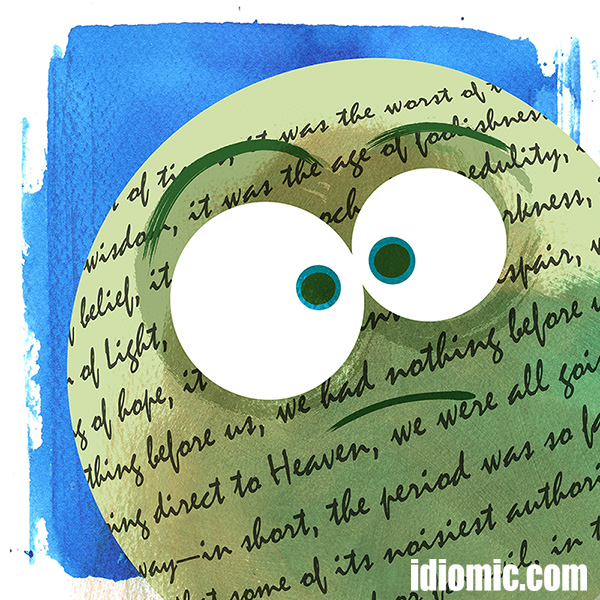
Native speakers are not perfect speakers.
Their speech is often unclear and their grammar can be sloppy. However, there are mistakes which they don’t make, and if you make them, you will sound like an English student, not the fluent English speaker you would like to sound like.
If you want to immediately sound better when speaking English, you need to avoid the following mistakes:

‘Charlie Brown’ by CHARLES SCHULTZ
Every English Sentence must have a SUBJECT. It must also have a verb. Think of the subject and verb as best friends who always need each other. Do you always include a subject or do you write things like:
“In Spain have a lot of beautiful beaches.”
“Have a lot of beautiful beaches in Spain.”
Where is the subject? “In Spain“ is an adverb because it tells you where the beautiful beaches are. Q. Where are beautiful beaches? A. In Spain.
Look carefully at those two words: In Spain. In is a preposition. Spain is a noun. Preposition + noun = adverb.
An adverb is not a subject! A subject is a noun: something or someone. Remember that a noun can be replaced by a pronoun: I, he, she, it, we, they, this, that, these, those, etc.
A subject is a noun or pronoun. (A noun can be more than one word. It can be a noun phrase or a noun clause. Let’s keep it simple for now and just look at one-word nouns.)
Spain has a lot of beautiful beaches.
It has a lot of beautiful beaches.
If you want to start a sentence with an adverb, that’s okay. Just make sure you use a subject before the verb:
In Spain, we have a lot of beautiful beaches.
In Spain, there are a lot of beautiful beaches. OR
There are a lot of beautiful beaches in Spain.
* We can use ‘There’ as a ‘dummy’ subject. We can also use ‘it’ as a dummy subject:
There he is!
It‘s cold.
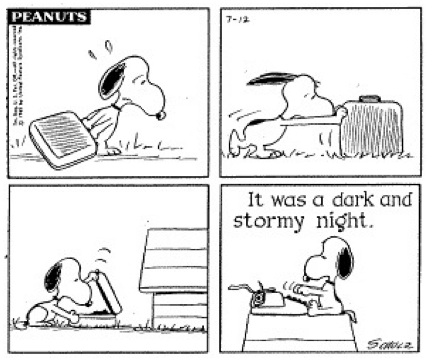
It was a dark and stormy night.
* Imperative sentences do not need a written or spoken subject. The subject is always understood as you. For example:
Think of the subject and verb as best friends. = (You) think of the subject and verb as best friends.
Look at the cartoon below. = (You) look at the cartoon below.
Don’t give up! = (You) don’t give up!
I constantly see writing mistakes that could be avoided if English students remembered a few basic suffixes. Suffixes are the letters we place at the end of a word to change it from, for example, a verb to a noun , or a noun to an adjective. Students know the meanings of words but use the wrong form. This really messes up their sentences. For example:
Don’t listen to rudely people and your life will be more peace.
Correction:
Don’t listen to rude people and your life will be more peaceful.
My homestay mother is very kindness.
Correction:
My homestay mother is very kind.
According to Cambridge Advanced Learner’s Dictionary, 2nd edition
“Words often come in families. You can expand your vocabulary by becoming familiar with these word families and this can also enable you to become a more fluent speaker and writer of English. If you know all the possible words within a word family, you can express yourself in a wider range of ways.” .
Suffixes are very useful! Think of a verb you know and see how you can change it with suffixes:
verb: (to) argue verb: (to) sleep
noun: argument noun: sleep, sleeplessness
adjective: argumentative adjective: sleepless, sleepy
adverb: sleepily
You don’t learn just one word whenever you learn new vocabulary. If you know a few common suffixes, you learn four or five or more words. You learn a Word Family. Isn’t that good news! The suffixes I have added above to the verbs argue and sleep are very common and don’t take long to learn. Let’s see how many suffixes we can add to the following nouns:

charlie-brown-imagesm4x6
noun: peace
adjective: peaceful
adverb: peacefully
noun: critic, criticism
verb: criticize
adjective: critical
adverb: critically
Click here for examples of common word suffixes –ment, and –ion, used in vocabulary which you need to know if you are studying for the TOEIC Test.
Click here for Cambridge Advanced Learners Dictionary for an extensive list of common words and other words in the same family. Suffixes and prefixes are included.
∗ TIP: When you learn a new word, check the meaning in http://learnersdictionary.com/. Then, check the Cambridge Advanced Learners Dictionary for the word family.
There are four important ways we use the letter ‘S‘.
1. ‘S’ Plural
2. ‘S’ Contraction
3. ‘S’ Possessive
4. ‘S’ 3rd person singular

Jamie-Lee Dwyer
I would like to introduce you to a friend of mine, Jamie-Lee Dwyer who is 26 years old. When she was eleven, and her sister Samantha was ten, they were both diagnosed with Friedreich Ataxia.
This has not prevented Jamie-Lee from excelling at University, travelling overseas, jumping out of planes, and among other things, becoming an accomplished writer.
I thought that you might be interested in reading what she has to say about her life. When you read her articles, it seems like she is talking to you (an impressive and rare writing skill) and you may even hear yourself talking back. I know that I do! I have even felt compelled to write comments back. Here is her latest contribution:
I decided to write this story because I want to show people that sometimes nice intentions are not so nice, they can be f∗∗∗∗∗ ! annoying. I don’t know how to say it in a more polite way, but let’s just say when you have people coming up to you every day just because you’re disabled it is beyond annoying. I hope this story helps people understand ‘our’ point of view a little more.
I was sitting opposite a friend from uni, sipping coffee and concentrating really hard on lifting the coffee cup up to my mouth. I was wearing one of my favourite dresses today and I’d be damned if I spilt it all over myself while I was out. We had just finished eating a delicious lunch at one of my local cafes and now we were catching up over coffee.
I’d forgotten how well I got on with this particular friend and I had just finished laughing like a lunatic when we were interrupted by a random middle-aged man.
The man knelt on one knee next to me and got right up close to me in my face. He looked at me through his square glasses with concerned eyes. ‘Darling, what’s happened to you then?’
∗Before you read more, please note that Jamie-Lee uses swearwords which may not be appreciated by all readers.
There is a lovely new song called Something just like this by The Chainsmokers & Coldplay. It has two verses and a chorus. The first verse is one long Compound Sentence. The chorus is a series of Noun Clauses, some of which contain Relative Clauses. The second verse is one long Complex Sentence.
Song: Something just like this
Verse #1:
I’ve been reading books of old, 
The legends and the myths,
Achilles and his gold,
Hercules and his gifts,
Spiderman’s control
And Batman with his fists,
And clearly, I don’t see myself upon that list.
Chorus:
She said *”Where’d you wanna go? * (Where do you want to go?)
*How much you wanna risk? * (How much do you want to risk?)
I’m not looking for somebody
With some superhuman gifts,
Some superhero, some fairytale bliss;
Just something I can turn to;
Somebody I can kiss.
I want something just like this.”
Verse #2:
I’ve been reading books of old:
The legends and the myths,
The testaments they told,
The moon and its eclipse,
And Superman unrolls
*A suit before he lifts, * (a superman suit ….. he flies)
But I’m not the kind of person that it fits.

** Many thanks to Rachael Crowe for the use of this photograph.** http://www.rachaelcrowe.com
| Verse #1: I’ve been reading books of old: The legends and the myths, Achilles and his gold, Hercules and his gifts, Spiderman’s control And Batman with his fists, and clearly, I don’t see myself upon that list. |
Verse #1: 1st Independent Clause: I’ve been reading books of old: the legends and the myths, Achilles and his gold, Hercules and his gifts, Spiderman’s control and Batman with his fists Co-ordinating Conjunction: and 2nd Independent Clause: clearly, I don’t see myself upon that list |
| Chorus: She said “Where’d you want to go? How much do you want to risk? I’m not looking for somebody With some superhuman gifts, Some superhero, Some fairytale bliss; Just something I can turn to; Somebody I can kiss. I want something just like this.” |
The Chorus is a series of Noun Clauses introduced by, She said.
Noun Clauses: “Where’d you want to go? |
| Chorus: She said “Where’d you want to go? How much do you want to risk? I’m not looking for somebody With some superhuman gifts, Some superhero, Some fairytale bliss; Just something I can turn to; Somebody I can kiss”. I want something just like this.”
♥ To watch the Youtube video with handy subtitles, click here. |
Because Noun Clauses can be whole sentences and questions, we can find Adverb Clauses and Relative Clauses inside Noun Clauses. Inside the Noun Clauses in this song, we find the following Relative Clauses: 1. … (which/that) I can turn to; In the examples of Relative Clauses 1. and 2. we can omit the Relative Clause marker: who/that. In example 3. we have omitted the Relative Clause marker ‘which/that’ as well as the BE verb ‘is’, so we call this a Reduced Relative Clause.
Verse #2: 1 … (which/that) they told, There is also an Adverb Clause in Verse #2: … before he lifts (Adverb Clause of Time.) |
♥ ♥ ♥ ♥ ♥ ♥ ♥ ♥ ♥ ♥ ♥ ♥ ♥ ♥♥ ♥ ♥ ♥ ♥ ♥ ♥ ♥ ♥ ♥ ♥ ♥ ♥ ♥
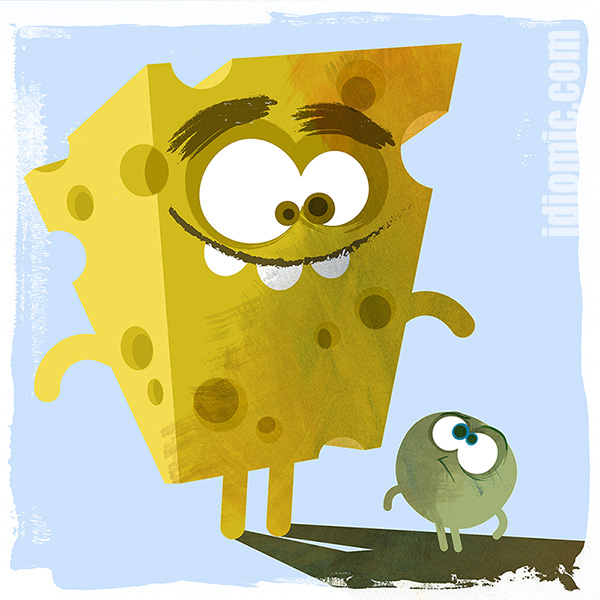
I have recently come across (phrasal verb: come across = found by accident) a very helpful website called idiomic.com which helps you understand and remember idioms and phrasal verbs by using amusing pictures. I have featured just one idiom below: BIG CHEESE
If you would like to see more of this wonderful website, just click on the picture of the BIG CHEESE. Once on the site, you can click on Follow at the bottom of the page to receive lots more pictures of idioms and phrasal verbs FREE.
 Winner of POQ Best English Education Website

My book, which is a visual explanation of the 12 tenses, is available at www.amazon.com Check it out!
 | mhardy3222 on The Crocodile and The Monkey :… |

 Mary's English Blog